Phaeton (Faeton, Φαέθων) was a planet that has recently (about ~ 3000 years ago) disappeared from our Solar System…
Author: Dr. Tom Chalko MSc, PhD
Ancient Greeks were known to diligently observe planets because they believed that “gods” traversed the sky and navigated between stars in space. Planets are fairly easy to distinguish from stars with the naked eye because they "move" in relation to the "fixed" system of stars and constellations that the ancient Greeks called "the cosmos".
The names that the ancient Greeks gave to the planets in our solar system are still recognizable today. There has never been any doubt as to which planet was which.
The Greeks know that some time ago there was a planet called Phaeton (Φαέθων) in our solar system that does not exist today because it disappeared with a great flash. The ancient Greek meaning of the word Phaeton is "shining", "luminous", "source of light". The words “photon” and “phaeton” come from the same ancient Greek root.
Phaeton was considered by the Greeks to be the “Son of Helios” (Son of the Sun) because of its extraordinary brightness compared with all other “gods.” The name and status given to Phaeton confirm that it was one of the brightest and most visible objects in the sky. As the “Son of the Sun,” Phaeton dominated the night sky much as the Sun dominated the sky during the day. It is quite possible that Phaeton was visible even in daylight (like Venus), sometimes appearing to approach the Sun and at other times moving away from it. This may be why it was given the title “Son of the Sun” (Son of Helios).
There is no way that the Phaeton was an asteroid, meteorite or some comet debris, because it would not have acquired the status of “god”. Phaeton was definitely a planet.
When Phaeton disappeared in a great flash, everyone in Greece knew about it. Its sudden absence would have been impossible to hide from those who had seen it throughout their lives.
Plato (427–347 BC), one of the greatest philosophers in history, realized that the commonly held belief—introduced by religion—that “Phaeton was destroyed by Helios’ lightning” was merely a clumsy interpretation of a real cosmic event.
Imagine generations of Greeks praying daily to their “god,” only to find one day that it had vanished. They could no longer pray to it, could they? For the ancient Greeks, the planet Phaeton was as real as the Sun.
The story of Phaeton is one of the best witness accounts of a cosmic event in human history. Documents can be altered, mistranslated, or destroyed. By contrast, information preserved in cultural traditions and language is extremely difficult to erase.
Some people may consider that the story of the planet Phaeton, which disappeared with a great flash, is the result of a collective hallucination or stupidity of Plato and the ancient Greeks.
However, there is material evidence that a planet did explode in our solar system. After such an explosion, the center of mass of the fragments should continue to orbit the Sun along a trajectory similar to that of the original planet, according to the law of conservation of momentum. The center of mass of today’s asteroid belt—between Mars (Ἄρης, Ares) and Jupiter (Δίας, Dias)—is near Ceres, the largest asteroid orbiting the Sun. Coincidence?
Since an explosion releases energy in all directions, the resulting mass distribution of fragments should be similar in both axial and radial directions, creating a torus-shaped belt. Indeed, the “thickness” of the asteroid torus between Mars and Jupiter is comparable in both directions. Another coincidence?
The considerable axial dimensions of the asteroid belt directly contradict the vigorously defended dogma that this belt is a remnant of the so-called “proto-planetary disc” that existed during the formation of our Sun and solar system. The problem with this dogma is that there is actually no disc - only a torus...
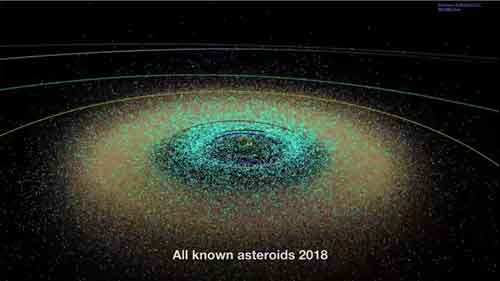
The “thickness” of the asteroid torus together with the mass distribution of all objects in the belt can be used to estimate the energy of the Phaeton explosion.
In 2020, Nature Astronomy published the results of a chemical analysis of a meteorite fragment that landed in the African desert [1]. This meteorite contains the mineral amphibole, which could only have formed on a planet-sized body in the presence of water. This strongly suggests that the meteorite came from a planet that no longer exists.
It might have originated from Ceres, the largest object in the asteroid belt, but how could such a fragment have separated from Ceres and landed on Earth? The explosion of Phaeton, witnessed by the Greeks and recorded by Plato, explains both the asteroid belt and the existence of Ceres.
On 26 September 2022 NASA conducted an impact test to deflect trajectory of a small asteroid in the asteroid "belt" called Dimorphis. The NASA spacecraft took close pictures of the asteroid before impact. Here is one of them:
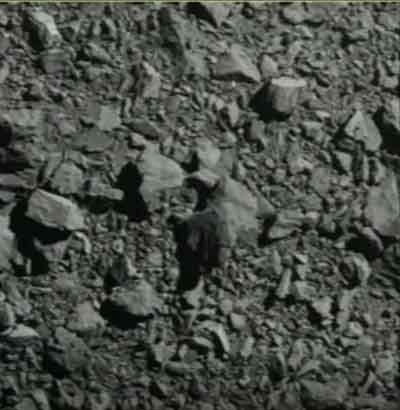
Surface of asteroid Dimorphis, targeted by NASA DART mission on 28 September 2022.
For NASA video of the impact approach please see
https://youtu.be/SbMNEhIv-eQ?t=200
NASA photos clearly show that Dimorphos is composed of rocky rubble, which NASA describes as “typical” for belt asteroids. But the question arises: how did these sharp-edged rocks and boulders form? The explosion of a rocky planet like Phaeton offers a highly plausible explanation...
The fact that, since the time of Plato, not a single scientist on Earth has considered explaining how a planet might disappear from the Solar System is a sign of the progressive decay of humanity on Earth.
Anyone who dares to accept Plato’s account, examine the evidence, and consider how a planet could disappear is branded a heretic—even though such research could lead to discoveries as important as those of Galileo and Copernicus.
Meanwhile, in the 21st century, astronomical maps of the Universe have once again become geocentric, just as they were during the time of the Great Inquisition.
A planet, like everything material in the Universe, decomposes over time. But the pace of this disintegration depends on many factors.
For example, it is known that 1 gram of plutonium will decompose over many thousands of years. However, 1 kilogram of plutonium will not survive even 10 milliseconds... When a radioactive isotope reaches the so-called “critical mass” - it explodes.
Can we guarantee that our reckless exploitation of the Earth and systematic overheating of its interior do not increase the likelihood of some radioactive isotopes inside Earth's reaching a critical mass ?
The story of Phaeton suggests that the existence of a planet in our solar system cannot be taken for granted ...
Do we need a planet Earth? Maybe not...
Try to find the following quote in the "Thiaoouba Prophecy" book:
"...sometimes a planet will disappear in a solar system..."

[1] Hamilton, VE, Goodrich, CA, Treiman, AH et al. Meteoritic evidence for a Ceres-sized water-rich carbonaceous chondrite parent asteroid. Nat Astron (2020). https://doi.org/10.1038/s41550-020-01274-z